
By The Tahona Editorial Team
Agave: What DNA Reveals
Written by
The Tahona Editorial Team
Published on
Mar 17, 2026
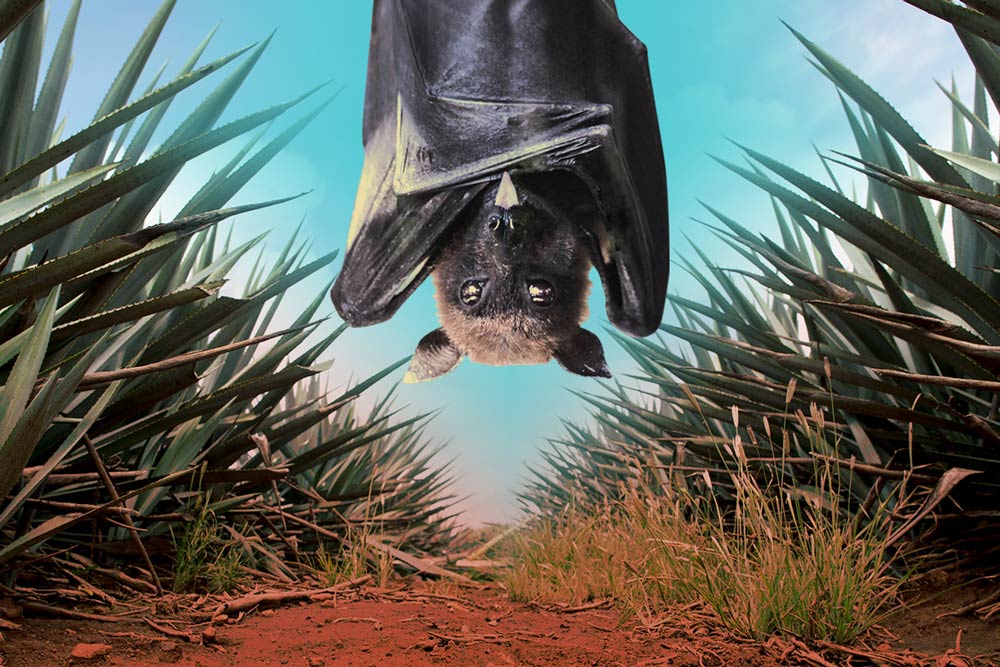
The tequila industry indirectly depends on bats. They are the primary natural pollinators of agave and help preserve the plants’ genetic diversity.
Bats, mysterious and a little gothic. “Mice with wings” that chose to become the nocturnal superheroes of agave fields.
With tiny faces, enormous ears, and long, bony hands, they spend their days hanging upside down like forgotten socks on a clothesline, wrapped in their own wings. But when night falls, they transform. They take flight with quick movements, sometimes traveling up to 120 kilometers in a single night, zigzagging through the air over Arandas before landing on nighttime blossoms. They are, after all, lovers of nectar.
The species Leptonycteris yerbabuenae, with its long snout and extendable tongue that works like a natural straw, drinks the sugary liquid produced by the flowers of Agave tequilana Weber. These flowers also attract bees, hummingbirds, and butterflies.
Nectar, composed mainly of sucrose, glucose, and fructose, along with water, amino acids, minerals, and aromatic compounds, is produced in large quantities by small glands in the plant called nectaries.
This sweet liquid serves as an energetic reward for bats. While they feed, they transport pollen from one plant to another, allowing agave to reproduce. In this way, they become the most efficient pollinators for many agave species, scientifically proving that the agave–bat relationship truly works.
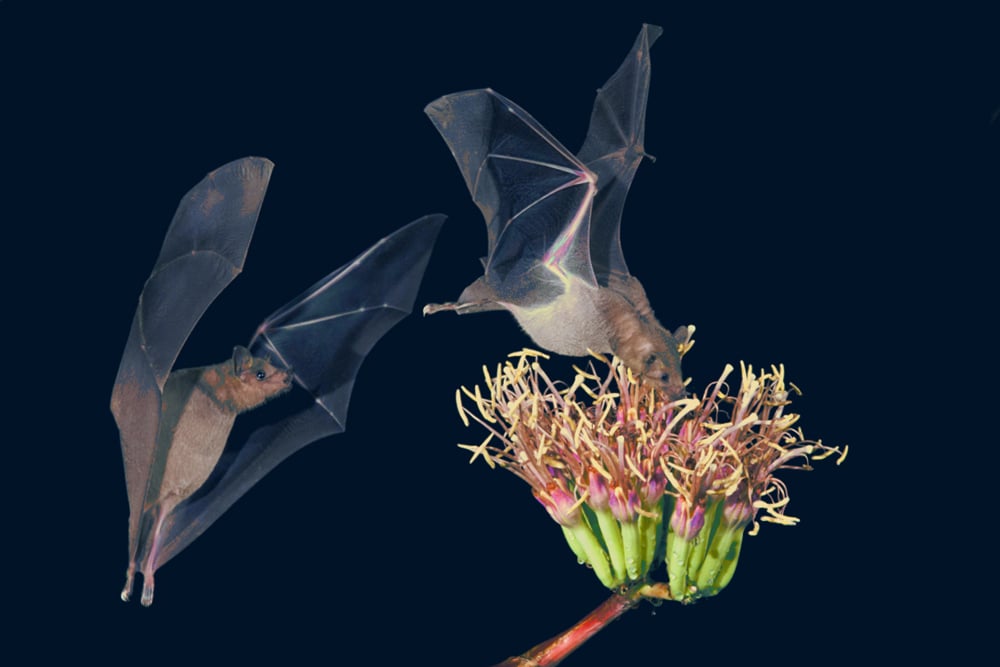
Another curious fact is that agave is one of the few plants that displays the chiropterophilous floral syndrome. In other words, it produces flowers specifically adapted for bats, according to the Autonomous University of Nuevo León.
When these flowers bloom at night, they produce large quantities of nectar and release a strong aroma. These traits evolved precisely to attract this flying mammal.
So the next time you see bats flying over agave fields, do not be alarmed. Instead, thank them for pollinating the plants that allow you to enjoy agave distillates.
Once Leptonycteris yerbabuenae drinks nectar from agave flowers, pollen sticks to its head and body. When it flies to another flower, the pollen is deposited there, enabling plant reproduction.
In other words, bats help agaves reproduce by transporting pollen from one flower to another. These animals also play an important role in seed dispersal and in controlling agricultural pests.
This is why it is so important for agave growers to allow some plants to flower. Otherwise, the ecological cycle would be disrupted, harming the ecosystem and biodiversity.
There is even an initiative called the Bat Friendly Project, led by Mexican scientist Rodrigo Medellín, often known as “the Batman of Mexico,” dedicated to bat conservation.
The project brings together researchers, agave producers, and conservation organizations under a clear goal. Encourage at least 5 percent of cultivated agave plants in the country to flower, allowing bats to feed and natural pollination to take place.
The idea is simple. Do not cut the quiote, the flowering stalk, before the plant blooms. That way, the bats keep their food source, and agave maintains its natural reproductive process.